
Most masala in this country is blended in a factory, poured into a tin with a mountain on it, and sold as if a region made it. The region did not. A woman did, or her mother did, and then a middleman took the name off.
Pounding Stone exists to put the name back. We began in Kodagu — Coorg — where the granite stone still sits under the eaves and spices are roasted by ear. That is the first pantry, not the whole map. A kitchen in the Northeast, a chilli from the Konkan, a pickle masala from Tamil Nadu — if a woman still makes it, we want her name on the tin. We pay the maker. We print her village. We tell the story in her words, not in ours.
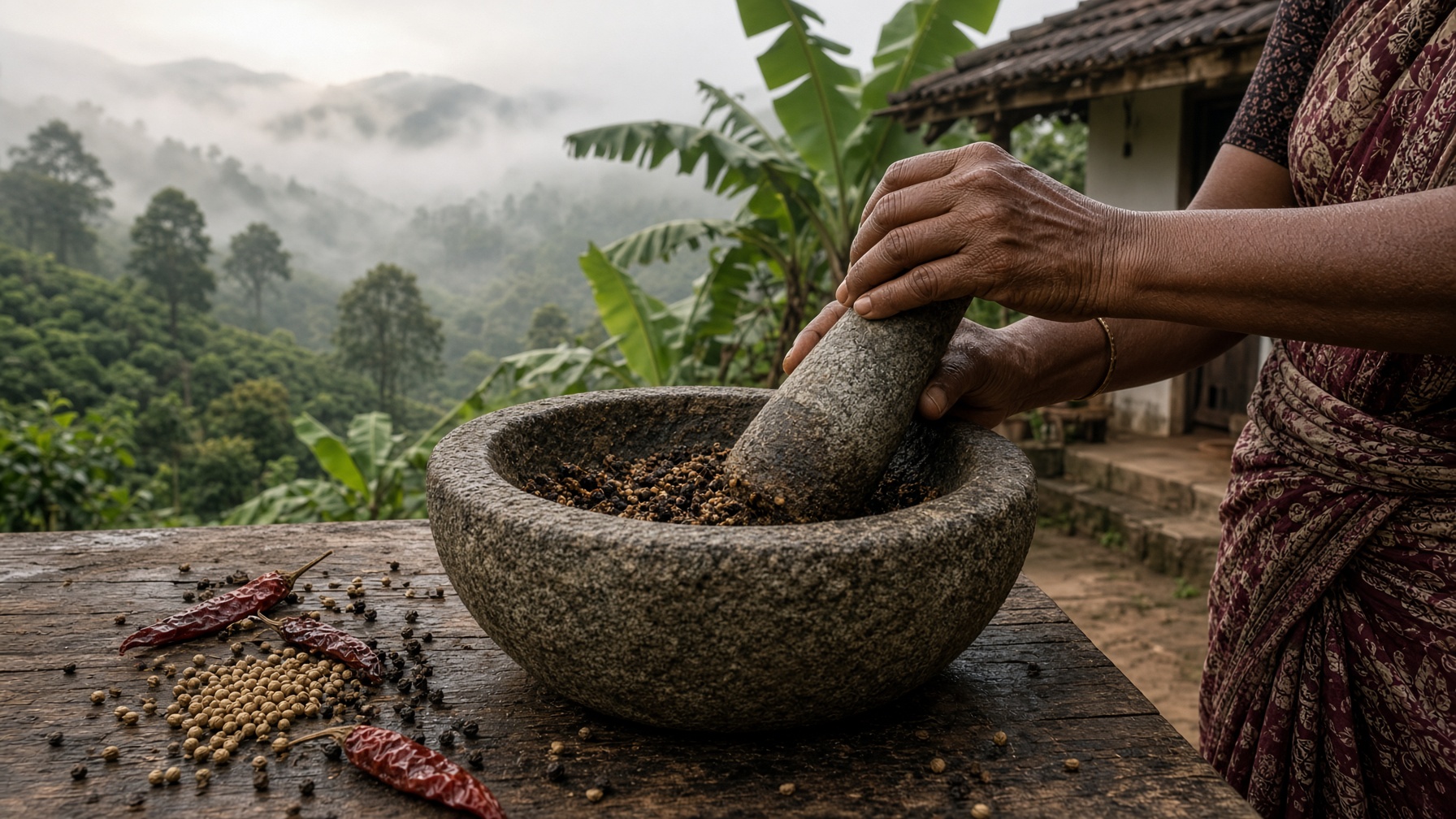
We began with three things the district actually cooks with: a dark meat masala from Susheela Appaji of Madikeri, kachampuli boiled by Subbi of Kutta in the monsoon, and bird-eye chilli grown behind Poovamma's house in Madikeri. That is the whole first pantry. We add makers from other states the same way — one woman, one stone, one tin — and never a generic blend. If your parent still makes masala, bring the recipe. We choose a few. If we take the kitchen on, we pay a royalty.
Online is the main market. The hills cannot feed a shop by walk-in alone, and the rest of the country should not have to go to Madikeri to taste this food. We ship pan-India.
Offline, a table is coming: Pounding Stone Kitchen in Bengaluru. Same tins on the pass, a pantry counter to take them home. It is not open yet. Until then, the shop is the tins, shipped pan-India.
We are not a museum and we are not a charity. We are a shop that refuses anonymous spice. If the tin does not carry a woman's name, it is not ours.